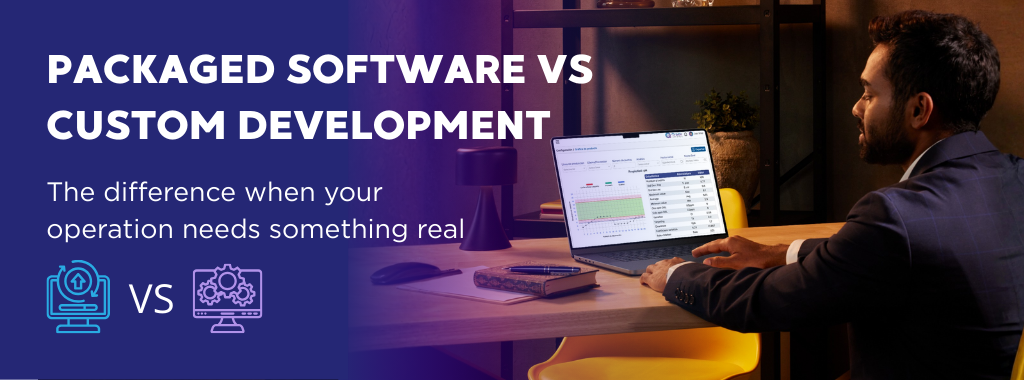
Packaged software vs. last-mile development: the difference when your operation needs something real
Many "configurable" systems promise customization but fall short when the operation requires rules, workflows and processes that don't fit into templates. Here we explain why last-mile development is the only path when you need technology that truly adapts to your business.
Configuring is not customizing: your operation deserves real technology
When a company evaluates technological options, they usually encounter two paths: off-the-shelf software that tries to fit through configurations and last-mile development, designed to replicate real processes. Although generic software may seem faster or cheaper, its limits appear exactly when the operation demands precision.
Off-the-shelf systems work until you try to adapt them to unique processes, specific integrations, non-standard workflows or rules that change rapidly. Their "customization" is actually just configuration: moving fields, changing labels, activating modules... but without modifying the underlying operational logic.
Off-the-Shelf software limitations affecting your operation
- Forced processes: you must adapt your operation to the software, not the other way around.
- Loss of traceability: incomplete or partial workflows create operational gaps.
- Superficial customization: only visual adjustments, no real logic changes.
- Limited integrations: difficulties connecting hardware, IoT or proprietary systems.
- Rework and internal friction: teams improvise to compensate for system limitations.

How does last-mile development work?
Last-mile development works in the exact opposite way of packaged software. It starts from your real operation: what you do, how you do it and why. It models rules, workflows, validations and exceptions, and integrates hardware, IoT, systems, data and roles to deliver a precise solution.
Key benefits of custom development
- Technology that exactly replicates your real-world processes.
- Total integration with systems, equipment, devices or infrastructure.
- Limitless scalability to grow at the pace of your operation.
- Flexibility to adapt to rapid changes in rules or processes.
- Operational stability without forcing workflows or improvising solutions.
When the operation depends on technology, "configuring" is not enough. You need precision, stability and a solution that grows with you, not one that limits you. That is why companies that come to Lionologies have already tried off-the-shelf software and reached the same conclusion: no amount of configuration replaces development designed specifically for your operation.